BudykoTransport

- class climlab.dynamics.budyko_transport.BudykoTransport(b=3.81, **kwargs)[source]
Bases:
EnergyBudgetcalculates the 1 dimensional heat transport as the difference between the local temperature and the global mean temperature.
- Parameters:
b (float) – Budyko transport parameter in units of \(\textrm{W} / \left( \textrm{m}^2 \ ^{\circ} \textrm{C} \right)\) [default value: 3.81]
As BudykoTransport is a
Processit needs a state do be defined on. See example for details.Computation Details:
In a global Energy Balance Model
\[C \frac{dT}{dt} = R\downarrow - R\uparrow - H\]with model state \(T\), the energy transport term \(H\) can be described as
\[H = b [T - \bar{T}]\]where \(T\) is a vector of the model temperature and \(\bar{T}\) describes the mean value of \(T\).
For further information see Budyko [1969].
- Example:
Budyko Transport as a standalone process:
import climlab
from climlab.dynamics.budyko_transport import BudykoTransport
from climlab import domain
from climlab.domain import field
from climlab.utils.legendre import P2
import numpy as np
import matplotlib.pyplot as plt

# create domain
sfc = domain.zonal_mean_surface(num_lat = 36)

lat = sfc.lat.points
lat_rad = np.deg2rad(lat)

# define initial temperature distribution
T0 = 15.
T2 = -20.
Ts = field.Field(T0 + T2 * P2(np.sin(lat_rad)), domain=sfc)

# create BudykoTransport process
budyko_transp = BudykoTransport(state=Ts)

### Integrate & Plot ###

fig = plt.figure( figsize=(6,4))
ax = fig.add_subplot(111)

for i in np.arange(0,3,1):
    ax.plot(lat, budyko_transp.default, label='day %s' % (i*40))
    budyko_transp.integrate_days(40.)

ax.set_title('Standalone Budyko Transport')
ax.set_xlabel('latitude')
ax.set_xticks([-90,-60,-30,0,30,60,90])
ax.set_ylabel('temperature ($^{\circ}$C)')
ax.legend(loc='best')
plt.show()
(
Source code,png,hires.png,pdf)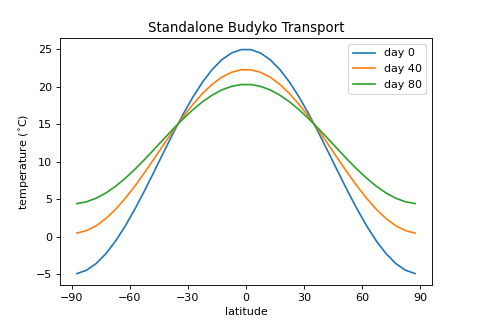
- Attributes:
bthe budyko transport parameter in unit
- current_time
depthDepth at grid centers (m)
depth_boundsDepth at grid interfaces (m)
diagnosticsDictionary access to all diagnostic variables
- elapsed_time
inputDictionary access to all input variables
latLatitude of grid centers (degrees North)
lat_boundsLatitude of grid interfaces (degrees North)
levPressure levels at grid centers (hPa or mb)
lev_boundsPressure levels at grid interfaces (hPa or mb)
lonLongitude of grid centers (degrees)
lon_boundsLongitude of grid interfaces (degrees)
timestepThe amount of time over which
step_forward()is integrating in unit seconds.timestep_in_secondsReturn a float value representing the timestep in units of seconds
Methods
add_diagnostic(name[, value])Create a new diagnostic variable called
namefor this process and initialize it with the givenvalue.add_input(name[, value])Create a new input variable called
namefor this process and initialize it with the givenvalue.add_subprocess(name, proc[, verbose])Adds a single subprocess to this process.
add_subprocesses(procdict)Adds a dictionary of subproceses to this process.
compute()Computes the tendencies for all state variables given current state and specified input.
compute_diagnostics([num_iter])Compute all tendencies and diagnostics, but don't update model state.
declare_diagnostics(diaglist)Add the variable names in
inputlistto the list of diagnostics.declare_input(inputlist)Add the variable names in
inputlistto the list of necessary inputs.integrate_converge([crit, verbose])Integrates the model until model states are converging.
integrate_days([days, verbose])Integrates the model forward for a specified number of days.
integrate_years([years, verbose])Integrates the model by a given number of years.
remove_diagnostic(name)Removes a diagnostic from the
process.diagnosticdictionary and also delete the associated process attribute.remove_subprocess(name[, verbose])Removes a single subprocess from this process.
set_state(name, value)Sets the variable
nameto a new statevalue.step_forward()Updates state variables with computed tendencies.
to_xarray([diagnostics, timeave])Convert process variables to
xarray.Datasetformat.

